- Podcast
- /
- The Hidden Risks of Complacency in Height Safety
The Hidden Risks of Complacency in Height Safety
Watch and listen on
DESCRIPTION
In this episode of The Height Safety Standard Podcast by Guardian, host Melissa Moss speaks with Andre Pelland, Vice President of Technical Operations at Guardian, and Angel Jimenez, Business Development Manager at Guardian, about the dangers of complacency in height safety.
The guests explain how complacency starts when leadership fails to provide the right tools or site assessments for workers. They discuss signs of a weak safety culture, such as treating safety talks like simple checklists and ignoring near misses. The group explores how human nature and past experience can lead to a false sense of security on the job.
Andre highlights the need for strong management systems and frequent site walkthroughs to stop accidents before they happen. The talk ends with advice on using digital resources and AI tools to stay updated on safety rules and equipment.
Andre Pelland and Angel Jimenez discuss how complacency impacts height safety in the workplace. They explain that safety issues often start at the top when leaders do not provide the right tools or site assessments for their teams. The guests point out that a weak culture is visible when workers treat safety talks like simple checklists or fail to report near misses due to fear.
They also describe how human nature and years of experience can lead to a false sense of security and risky habits. To fix this, Andre suggests using strong management systems and regular site walkthroughs to find hazards early. The group concludes by highlighting digital tools and AI as great ways for companies to stay updated on new safety rules.
In this episode, expect to learn:
- How complacency in height safety stems from a lack of proper site assessments and using the wrong equipment for the job.
- Why human nature and years of experience can create a false sense of security that leads to risky habits and normalized behavior.
- How to identify a weak safety culture through signs like checklist-style toolbox talks and the fear of reporting near misses.
- The role of leadership in providing the support and guidance needed to stop complacency from running rampant in an organization.
- How companies can stay ahead of changing regulations by using management systems, site walkthroughs, and digital AI tools like Gabby.
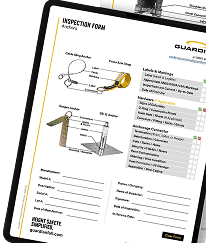
Free Download
Fall Protection Pre-Inspection Checklist!
Help your team catch hazards before work begins.
Andre Pelland
Vice President of Technical Operations
Angel Jimenz
Business Development Manager
Transcript
Melissa Moss (00:00):
When complacency starts to creep in, what are the real consequences companies face?
Andre Pelland (00:04):
There's a whole spectrum of consequences, the real consequences, loss of life, and that is what we're obviously always working down from. We're starting from the worst case scenario, working our way down. So
AI Intro (00:18):
Meet Andre Pelland, vice President of technical operations at Guardian, and Angel Himenez, business development manager at Guardian, here to talk about how complacency shows up in height, safety, and what it takes to fight it.
Melissa Moss (00:29):
When you're out working with companies on compliance, how does complacency actually show up day-to-day?
Andre Pelland (00:35):
I can sum it down to a top to bottom issue. So leadership has to ensure that they're providing their boots on the ground, employees with the proper support, the proper guidance on how to identify those specific areas where they could become complacent.
Angel Jimenez (00:53):
One of the biggest takeaways in this is leadership. Are they actually walk the walk? If a supervisor is not going through the job and actually identifying potential assets and challenging them, that's one of the biggest takeaways.
Melissa Moss (01:05):
Why is that complacency so tough to break? I mean, even teams that care about safety and have good intentions, they seem to fall into a trap. What's behind that?
Angel Jimenez (01:13):
One of the things that I see often is this.
Melissa Moss (01:17):
Think about the most dangerous things in height, safety. What's running through your head? Faulty harnesses, missing anchors. In reality, there might be an even bigger threat. Complacency. You can have a team that's gone through all the training and has all the right gear, but falls can still happen if they think they have everything under control. Complacency slips in when routines turn into habits, and if you start skipping one step, you'll start skipping more. It's a silent danger that needs to be spotted before it causes serious harm. I'm Mel Moss guardian's, director of marketing, and this is the height safety standard. Your definitive playbook for safer, more effective work at height. Let's set the higher standard for height safety. Starting now by eliminating complacency. Welcome to the height safety standard, where we ditch good enough and set a higher bar and height safety. Because when you take a 360-degree approach, the safe choice is a simple one.
Melissa Moss (02:16):
That's our gold standard height. Safety, simplified. Trying to reach that standard with a culture of complacency not happening. Just ask today's guess. Andre Pellen and Angel Jimenez, who are both experts at building proactive height safety cultures. Andre is guardian's VP of technical operations and he has years of experience helping companies meet OSHA requirements and build better, more effective programs. Angel Guardian's business development manager leads our own internal safety culture and knows what sets the safest companies apart. Welcome to the height safety standard, Andrea and Angel, let's set a higher standard for height safety by eliminating complacency. Andre, when you're out working with companies on compliance, how does complacency actually show up day to day? Yeah,
Andre Pelland (03:14):
Thanks for asking, Mel. From my perspective, where I see complacency, it's not specifically one area to me. It's a variety of areas, but the easiest way to boil it down is from top to bottom. So leadership to boots on the ground and in starting from the boots on the ground. When I speak to any individuals that are practicing specific applications or setting up specifically for a job that you might demonstrate a level of complacency, it's usually when they're using same old tool for a new job. And from my perspective, that is a lack of site assessment, and it's a lack of knowing exactly what they should be looking for and what equipment they should be using for that specific application. And that is driven from the top down. So leadership has to ensure that they're providing their boots on the ground, employees with the proper support, the proper guidance on how to identify those specific areas where they could become complacent. And that to me is the holistic issue, is that it's not one person that's doing it wrong. I think it's as a whole and it takes an entire system to make sure that complacency is not running rampant in your organization.
Melissa Moss (04:46):
Thank you. And angel, from a cultural standpoint, what are the signs that a team isn't fully engaged and is just going through the motions?
Angel Jimenez (04:54):
I see this every day in our line of work. When you talk about full protection and safety, there's a big difference for a company to talk about safety. The ones that actually live it from a cultural standpoint, there's signs they're every there if you know what you're looking for. For example, a workplace that goes through the motions when it comes to a toolbox talk and treating it like a checklist more than the actual value. Also, you see people in the field, it doesn't really translate in what they do every day. Other one of the biggest giveaways from this is how they react to the issues. And we cultures, you see a lot of the interest that you've been identified on how they report near misses or they get on the reporter because of fear for repercussions, and they don't take it to learn from them.
Angel Jimenez (05:41):
They see it as something that is faulty and something that it could be an issue moving along. Also, you're noticing the equipment in the planning. You go from a harness inspection that takes time into just a quick glance and just go in about your day. You also see one of the biggest takeaways in this is leadership and how they actually don't walk the walk if a supervisor is not going through the job and actually identifying potential hazard hazards and challenging them and identifying so we could correct them in the future. That's one of the biggest takeaways.
Melissa Moss (06:15):
Great, thank you. And Andre, walk us through what it looks like when complacency starts to creep in, whether it ends up with a citation or worse, an actual incident. What are the real consequences companies face?
Andre Pelland (06:27):
Well, I mean there's a whole spectrum of consequences, but if we're going to pinpoint some of these minor consequences that I run into on a daily basis, it's mostly actually speaking with the regulators. They call manufacturers all the time and ask, are these specific pieces of equipment compatible? So that is what complacency does. It creates misuse, it creates incompatible applications. And like I said, I see this day in day out and I have to basically walk either individuals or regulators through how this equipment is used. So the consequences, I mean obviously from a regulatory standpoint is that there's going to be a citation handed out, but the real consequence is loss of life. And that is what we're obviously always working down from. We're starting from the worst case scenario working our way down. So in some circumstances, I mean there are some incompatible applications and that just goes as far as a citation and educating.
Andre Pelland (07:38):
But there are some incompatible applications or setups with multiple pieces of equipment that have absolutely no business being used together. And that is where it can potentially lead to serious injury or death. And that's, to me, what could happen. So the severity is very, it's very broad. So it could be as minor as having to pay a citation, but it could be as serious as in dealing with fatality on site. And the complacency obviously is where it starts. But from my perspective, I think that really it's going back to that education piece. It's very important to educate because I think the complacency really does stem from being uneducated and understanding what the consequences could potentially be. As soon as you tell an end user or a safety director, this could actually lead to a fatality and show them the evidence of that. I think that's when people really start to open their eyes. I mean, that's how I think that complacency can lead to citations. It's just not providing your people with the right information.
Melissa Moss (09:05):
Thank you. And Angel, why is that complacency so tough to break? I mean, even teams that care about safety and have good intentions, they seem to fall into a trap. What's behind that?
Angel Jimenez (09:15):
One of the things that I see often is this experience. A lot of guys relied on experience and that could be a plus, but also could be vulnerable because the mentality of I've done it a million times and nothing has happened, why should I change it now at a human level, our brains are wired for efficiency. So we do it the first time and we see that nothing happened, we got to continue doing it, and it gets more familiar. It's like muscle memory. You got the pressure of the job and you start missing a tie off once, and then you do it a 10 time and you do it, you ignore it, not because it's a good thing, it doesn't feel good, but it's memory. You start doing it. Once you do it again, then you normalize the behavior. Another factor that is that you've got to keep in mind that one time nothing happens, that's the problem. You're going to continue doing it because nothing has happened. That's the kind of mentality that will have to fight from the bottom up. The fact that actually performing the work that the mentality needs to.
Melissa Moss (10:11):
Why is complacency so tough to break even teams that seem to care about safety and have good intentions seem to fall under that trap. What's behind that?
Angel Jimenez (10:19):
Well, complacency is tough to fight because it's not just a bad habit, but it's just how people think. The human level, our brains are sort of wire for it being efficient. We tend to do one thing once, do we do it again? And then just because muscle memory, we want to do it not because it feels right, but we become accustomed to the sort of culture. That's some of the things that we face in the field, especially the real pressures of a job and deadlines and everything else is some of the things that make that habit so hard to break. Also, experience could be it's a plus. There's something that is valuable in the field, but that could be that false sense of safety. I've done it a million times, why should I change it now? Nothing thing has happened, I should be fine if I continue doing. Those are the things that make it hard to break that habit.
Melissa Moss (11:08):
If a safety manager is listening right now and they're worried that their team might be getting complacent, what are the first few things they should start looking for?
Andre Pelland (11:17):
That's a good question. Yeah, just thinking through that. Think when I explain to safety directors, or even just speaking to anybody internally at our organization looking at safety is any other management systems goal is continuous improvement. And I always look at it from look outside the box. It's not the typical things that you're usually going to see cause any accidents from complacency, it's usually those underlying hazards that it's just without doing the proper checklist and doing the right site assessment or even work assessment before starting any task for that matter. I think it's really important for safety managers, safety directors to really focus in on what could possibly go wrong that we haven't thought of yet. And I think that you could look at it from a checklist standpoint, which I've mentioned, but you should also look outside the box. It's not always going to be the same potential hazards that put your life at risk or put anyone at risk for that matter.
Andre Pelland (12:35):
It's going to be, in many cases, those things that you don't assume are going to happen. And I've seen certain things where it's because someone was tired, they didn't get to sleep, they're feeling under the weather or something like that. So it's very important for safety managers, directors to really focus in on those types of things, like those little potential outliers. So always getting a temperature check on personnel, just encouraging them to do a thorough site assessment before they start anything is what I would always encourage them to do is just always expect the unexpected.
Melissa Moss (13:15):
Good points. Very good points. And then once you've identified complacency, how do you actually reset the culture? What does that process look like? Well,
Andre Pelland (13:25):
I've mentioned the management system. So the way that we identify those types of issues and eradicate them is by doing site walkthroughs very often filling out forms, doing a multi-level assessment with multi-level personnels. So you would have managers and then you would also have some of the personnel that work in those departments and people that also work outside of that department. So we all get in as a committee and we complete those walkthroughs and we identify things with a third party perspective and we just run them through a nonconformance process. So we find out what the root cause is, we apply a corrective action and then we monitor that those corrective actions have actually been successful at eradicating those issues. So that's how I don't do a complete reset. I'm more proactive in my approach. I like to look at things before they happen. And we have been lucky at this specific organization at eliminating any of those potential hazards before they happen, by doing those types of things and treating it like a true management system. So best ways to do or implement any of those things is following an ISO 45,001 program, whether you're certified or not, just build one of those and really build it into the culture of the organization and get everyone to treat it like it's everyone's livelihood that's at risk. So it's not a complete reset when we do any of it, is just making sure that we constantly have our fingers on the pulse.
Melissa Moss (15:15):
Right, right. Very good. Alright, let's get in the weeds here, Andre. What role does regular equipment testing inspection play in fighting complacency? How often should companies be testing? Yeah,
Andre Pelland (15:26):
So I guess from that perspective, the complacency would come in from, I guess the OEM or the manufacturers or the providers, complacency where they're expecting their product to always perform the same and never really account for any variability in their product. So the way that we apply those concepts to our product, the testing concepts is everything is based on risk and a product is sent out that hasn't failed in decades. That is a lower level of risk, and that's, we apply a different A QL to that specific product. But some products are more prone to potential quality issues, and those have higher a qls, we test them more, we have more inspections complete on them, we have more points of inspections to complete them. So the role of equipment testing is also kind of on a spectrum as well. It's like there's only so much resource that you have to make sure that you're testing as much as you possibly can and eradicate as much risk as you possibly can. So there are certain products that a lump of steel, for lack of better terms, would be much less susceptible to destruction than a piece of webbing. So we're obviously going to be spending our time on that piece of webbing that is much more susceptible to tearing to UV degradation, to any of those types of things that would exacerbate the destruction of that specific product. So once again, it's not a straightforward answer, but it is more or less on a spectrum that we fight complacency in distribution of product, if that makes any sense.
Melissa Moss (17:21):
Yeah, it does. It makes great sense. And let me go on a little bit more on that where I'm kind of headed with this. As regulations kind of continue to evolve, how can companies stay ahead?
Andre Pelland (17:31):
The best way for companies to stay ahead of regulation changes and industry standard changes, which in our case is going to be consensus standards such as A-C-C-S-A-I-S-C-A-A-S-T-M, those specific standards for you to stay ahead of those types of standards, you need a good program just like anything else for quality, you need a quality management system for health and safety, you need a health and safety management system where you also need a system in place that keeps you up to date on future changes to regulations, future changes to consensus standards. So the best way to do it is research, making sure that you have people that are tasked to make sure that you're always ahead of it and you're always doing that research. You're keeping tabs on osha, you're making sure that you're fully aware of what OSHA is planning on doing, if there's any call for opinion, call for complaints, any of that sort of thing, making sure that you're staying engaged in that sense.
Andre Pelland (18:37):
And then also making sure that you're staying engaged with the consensus standards. It is not easy for a company to stay up to date like that. It takes a lot of resource. It takes a lot of personnel to gather all that information and making sure that all of that specific information that is out in the field is being brought into your organization and deliberated appropriately because that information is not going to make its way into your organization by itself. So you have to go out there and you have to capture it and then bring it back in. And those are the types of programs that you need to put in place. Any organization that is interested in staying up to date with their specific regulatory requirements or specific consensus standards that apply their industry. So my final point is that is just having a proper and robust system in place. Angel,
Melissa Moss (19:37):
What excites you about the future of height, safety, culture?
Angel Jimenez (19:41):
I'm excited about change, Mel. That's one of the things I'm most excited about. I want to make sure that every man and woman with home at the end of the day, and I think we definitely are a big participant in this because we are trying to change human nature. When people do good at work, we usually translate to their daily lives. So it's about changing behavior. It's one of the things I'm looking forward to seeing. Of course, we make great product. I want to see innovation especially make available for guys and girls in the field, again to make sure that they go home at the end of the day.
Melissa Moss (20:14):
Andre and Angel, thank you both for showing us how to combat complacency in our pursuit of height, safety excellence. If listeners want to learn more about guardian's compliance programs or safety resources, where should they go?
Andre Pelland (20:27):
My master resource, I don't just recommend this to people, I use it myself. Whenever I feel like I need a sanity check on anything, I go to the Guardian website. And that website to me is a resource where you can find instructions, you can find labels, you can find technical data sheets, you can find all of our conformity paperwork. So that includes our test records, that includes declarations of conformity. Additionally, you can also ask our chat bot Gabby, she's able to lead you to any of those resources. Yeah, so for me, my go-to is always going to be the Guardian website.
Melissa Moss (21:12):
Excellent choice to go. I mean, there's a ton of resources on there. There's training programs or digital tools. I couldn't agree with that more. Thank you both. Thank
Angel Jimenez (21:20):
You guys. Thank you.
Melissa Moss (21:21):
That'll wrap up today's conversation. Thank you so much for tuning into high safety Standard where we're ditching good enough and setting a higher bar in high safety. Because when you take a 360 degree approach, the safe choice is the simple one. If you want to explore more ways to set a new high safety standard, visit to explore our compliance resources, training programs and digital tools, including Gabby, your 24 7 AI height safety assistant, or visit to explore more episodes and get our fall protection inspection checklist. Let's set a higher standard for height safety starting now.
