- Podcast
- /
- The Differences Between Active & Passive Height Safety
The Differences Between Active & Passive Height Safety
Watch and listen on
DESCRIPTION
In this episode of The Height Safety Standard Podcast by Guardian, Host Melissa Moss speaks with Daniel Carr, Business Development Manager at Guardian, about the differences between active and passive fall protection. Daniel explains when each system should be used and why passive protection is often the preferred option when possible. He discusses how poor training, misuse of equipment, and a focus on productivity over safety can increase the risk of falls. The conversation also covers the importance of clear safety policies, proper planning, and hands-on education for workers. Daniel shares his thoughts on new developments in fall protection, including the growing use of self-retracting lifelines, and ends with advice for safety professionals on building strong relationships and improving safety culture.
Daniel Carr discusses the differences between active and passive fall protection and explains why passive systems are often the preferred choice when job conditions allow. He shares how poor training, improper equipment use, and a focus on getting work done can increase fall risks on the job. Daniel also highlights the importance of clear safety policies, hands-on training, and proper planning before working at height. The conversation explores how self-retracting lifelines are changing the industry and helping reduce fall hazards. The episode concludes with practical advice for safety professionals on building strong relationships, learning from experienced workers, and creating a positive safety culture.
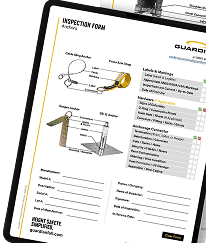
Free Download
Fall Protection Pre-Inspection Checklist!
Help your team catch hazards before work begins.
Host - Mel Moss
Director of Marketing at Guardian
Dan Carr
Transcript
Daniel Carr (00:00):
Safety is not an absence of hazards. It is a presence of control. Another facet of that that I think is often missed is the concept or the idea of what I call ornamental fall protection. That specifically is
Intro (00:14):
Today our guest is Daniel Carr, business development manager at Guardian. With over 15 years in occupational health and safety, he has spent his career bridging the gap between written safety policy and real world execution on job sites.
Daniel Carr (00:27):
Statistics show that people are still falling every day. When I teach my confident person class, by the time we finish, I will tell them four people died. When
Melissa Moss (00:34):
We talk about active and passive fall protection, what's the difference?
Daniel Carr (00:38):
Passive is always present. Passive is always there. It's there if the workers are there or not.
Melissa Moss (00:44):
Based on everything that you've learned in 15 years in health and safety, what's the one thing that you wish safety professionals understood earlier about active and passive fall protection?
Daniel Carr (00:54):
I have learned so much more from people that
Melissa Moss (00:59):
Here's a question that comes up on nearly every job site. Should you use guardrails or harnesses? It sounds simple, but the answer changes everything about how you protect your crew. Active fall protection, which includes harnesses, requires workers to connect and use the equipment properly. Passive protection, which includes guardrails, works automatically without relying on the worker to do something right. Both have their place, but do you understand when to use each? I'm Mel Moss guardian's, director of marketing, and this is the height safety standard. Your definitive playbook for safer, more effective work at Height. Let's set a higher standard for safety. Starting now by understanding the difference between active and passive fall protection. Welcome to the high safety standard where we ditch good enough and set a higher bar and height safety. Because when you take a 360 degree approach, the safe choice is a simple one. That's our gold standard Height safety simplified. And if you think simplify height, safety faster than understanding when to use passive and active protection, just ask today's guest. Dan Carr, Guardian's business development manager and a certified safety professional with 15 years of health and safety experience and a master's in safety, security and emergency management. Today he's breaking down exactly which controls work best in some of the most common situations workers will face at height. Welcome to the height safety standard, Dan. That's set a higher standard for safety by understanding active and passive fall protection.
Melissa Moss (02:38):
Alright, Dan, let's start with the basics. When we talk about active and passive fall protection, what's the difference? What
Daniel Carr (02:46):
It says? So passive is always present. Passive is always there. It's there if the workers are there or not. All of us on this call of use passive for all protection before when we're at the mall at an amusement park now, and I'm talking maybe a little more overly simplistic than I should be because many times we think of passive as guardrails, but it's also hole covers, nets, things of that nature. But a passive fall protection is just it, in my opinion. I don't want to say safer, but it's just, it's always there. It's always present versus passive. And passive is where you're actually hooked in. You are actually connected. You have an anchorage, you have a connector, you have body harness. When I tell people, because I am senior trainer for Guardian, is that when we are in active fall protection, we have to anticipate that a fall is going to happen because if it does, so I mean in its simplicity, that's what the difference is between active and passive.
Melissa Moss (03:44):
What is your guiding philosophy in choosing between the two systems of active or passive?
Daniel Carr (03:48):
Well, I mean the guiding philosophy is me at least just keep in mind, I spent many years as a safety manager and first off, it more feasible. And what I mean by that is if I can utilise passive fall protection instead of active, if the work site allows for it, that's going to be my guiding principle because it takes a lot of the guesswork out of it. It takes the, because when you're using active fall protection, you have the human element. We properly planned for it. Have we been trained in, have we inspected? Have we dawned it? Do we understand all of the idiosyncrasies that goes beyond not just putting on a farm? So I mean, that's my guiding philosophy is if we can use passive, we should. But industry and current job requirements would suggest otherwise that people still had to use active fall protection.
Melissa Moss (04:45):
So what are the biggest barriers? You mentioned before is people believing that the safety controls diminish productivity. Does that mindset actually affect the active and passive decision for fall protection?
Daniel Carr (04:57):
Yes and no because I will tell you that early on in my career we saw that, I've always referred to it as the get it done mentality now, and we have to keep in mind that there are a lot of folks who are decision makers. This is not a slam on anyone, but they came up in industry at a different time. I actually had one of the first people that ever gave me a shot in occupational safety told me a story that he bid a job in the either late eighties or early nineties, and they were laughed out of the room because they bid a job with harnesses instead of body belt. And so as things are progressing, I do see that moving out, but I do think that there's still a thought process just because I've had people tell it to my face when I was on job sites, all this safety stuff, it's just getting in the way my job's to make money.
Daniel Carr (05:45):
That's what we're here by God, we got to make it happen hand. That's what we're going to do. And I don't fault people for thinking that way because a lot of it is what they've always thought, but it's also what they're paid to do. So I do see though that industry and focuses are changing to a more positive safety culture thought process. Dr. Todd Conlin has a great saying, and Conlin is, he actually has a podcast I listen to when I can, his definition of safety is that safety is not an absence of hazards. It is a presence of control. And when companies lock guardian, and what we are essentially doing is we are presenting controls, the hazards because we accept that the hazards are still there and how do we best control them. But I do see that the thought process still in industry, and we're still going to come across it, is actually, I had a guy tell me, I'm not paid to be safe. I'm paid to get work done. And that's just, but I feel as though that as things progress that a lot of that mindset is there, but we'll never fully get rid of it.
Melissa Moss (06:58):
What do some of those good policies look like for safety professionals, especially as it relates to fall protection?
Daniel Carr (07:03):
So this is something that's, I don't want to say a loaded question, but it is an interesting one because we have to ask ourselves essentially what policies are and policies are the written rules and practises that we are going to do to properly achieve our goals. And all too often, I think something that is overly done, and once again I've seen this is someone will write an 87 page policy and it's a good policy and in their opinion at the same time, is it feasible? What is it saying? And more so how do you disseminate that, all that information down to your employees? How do you decide that osha, if we look at certain requirements in osha, and this is kind of an offshoot, but specifically the confined space standard that OSHA has written, OSHA considers that a performance standard, IE, they tell you the intention, it's up to you to set the execution often try to encourage people to take that mindset when you rock policies for your site, for your company. In that we discussed when I was in grad school, Dr. Schneider, one of my professors talked about the grey area that all safety professionals have to work in that many times things are not black and white. But I tell people that a good policy for one needs to be concise, it needs to be easily digestible and it needs, but more importantly is you need to have positive ways and encouragement of how to get that information to the folks that have to follow it.
Melissa Moss (08:39):
So what are the most important things that people miss with active fall protection?
Daniel Carr (08:43):
Well, it's a couple of things, but for one, I think in industry we talk about the ABCs of fall protection, but companies like Guardian, we actually had the A, B, CD and ease of fall protection. So the D is for dropped objects or E essentially is education and training. And I often have felt, and I was actually guilty of this early off in my career, that in general we don't do as thorough of a job in educating our employees in the proper use of fall protection in deciding which is what the differences is. The differences are education is so important and being able to actually, it's not giving someone a PowerPoint or sending 'em to the safety council. And this is not me slamming on the safety council. They serve a very important role, but you can't exclusively rely on somebody sitting in front of a presentation and going through a lecture.
Daniel Carr (09:37):
Have you actually seen them put it on? Have you showed them how to inspect it? Have they been hoisted up and deployed their trauma straps? Do they understand where the proper tie offs are? I think that that in general can be miss with some in industry for some people. And that to me is just such an important piece of it. Then I'll tell you another facet of that that I think is often missed is the concept or the idea of what I call ornamental fall protection. And that specifically is someone that they put on a harness and they used some kind of connector. And because I'm tied off and because I'm in a harness, I'm protected. I'll give you a great example. I worked a shutdown a number of years ago and I had a young man who was working and he had tied a six foot lanyard, which was against the instructions of it per the manufacturer, and he had hooked it to a 32 foot SRL, of which he probably cooled about 20 feet of the out.
Daniel Carr (10:37):
Now he was working 22 feet in the air. In his mind he was protected, but I said, you're going to hit the ground if you fall. And it goes back to the education. He had not been educated, he had not been shown the proper thought process. He didn't even understand the equipment. He just thought because he was tied off, he was safe. And that's definitely, in my opinion, still going to be the root cause of a lot of issues that we can find because statistics show that people are still falling in this country every day. I mean, I think the last time I've looked at statistics, because when I teach my competent person class, I will tell them that by the time we finish this class, I want to say four people died.
Melissa Moss (11:21):
That's shocking but true.
Daniel Carr (11:22):
But it is true and it is unfortunate, and I recognise that there are people probably going to say this and say, well, that's not exclusively in fall protection. It wasn't working at this high or that high, and that's fine. But the fact of the matter is people are still dying in this country due to falls, and in many cases, in my opinion, it's misuse of equipment and it's misused in not proper planning of your work at height.
Melissa Moss (11:47):
So let's flip the coin on this one now. So looking at the innovation in fall protection, what excites you about where active and passive systems are headed?
Daniel Carr (11:55):
So for me, I would say that passive for the most part is in a lot of ways where it is. When I start thinking about active fall protection, one of the things that I see industry going to right now is the use of SRLs or yo-yos as many people call them. And they've come a very long way in just a few recent years as far as what the requirements are. And for me, I'm very interested what the next innovation will be in that. And it could just be how quickly your movement speed is, or these are things that I think about because I drive a lot, but we haven't really seen a lot of innovation in connectors in recent years. So I'm wondering, what's the next big connector? What's the next big breakthrough in that? But to me, s ls are going to be the future. Lanyards will never go away, but we're seeing more and more companies start to go towards end and say, this is what we're using. We're not going to use a standard lanyard anymore. And that's good. I think we will see people move more towards the SRL category and away from lanyards, whereas maybe 15 years ago that wasn't the case.
Melissa Moss (13:12):
Yeah, I've noticed more people moving towards the personal SSLs. So on the side, what risks do they eliminate for the worker and why does that matter? There's
Daniel Carr (13:20):
A number of them. For one, when you're using a standard lanyard, you have access. You actually have something that trails behind you. It's something you can trip over. It's right there, especially if you're moot using, so like pacing, pulling a basket or something like that. But it also, you do have the risk around rotating equipment of entanglement hazards. And I actually had a pretty significant event. It was not a lanyard, it was a tool tether, but when I was a maintenance contractor, I actually had a tool tether get sucked into a fin fan and it ripped it right off the guy's tool bag and actually threw it in the bottom of the fan. So there's that, but then with an SRL as well. So the S RLS only give you what you take. As you move it, it will move with you and it'll extend out, but as you move back, it goes back up inside the housing.
Daniel Carr (14:11):
That's important because when using an SRL, especially when you can tie fat or above the dorsal D ring, you greatly eliminate the amount of free fall. And then I'm not talking about deceleration difference, I'm talking about distance, and you're eliminating much of that. Whereas with a lanyard, you're always going to have six feet that you have to account for or whatever the length of the lanyard is. So you have to have that and you have to know it's there. And you basically eliminate or greatly reduce that with an SRLS SRLs are also very more durable and they need much, much less fall clearance below them to properly arrest the fall.
Melissa Moss (14:48):
So based on everything that you've learned in what over 15 years in health and safety, what's the one thing that you wish safety professionals understood earlier about active and passive fall protection?
Daniel Carr (15:00):
This is going to be more of a generalised observation, but it's important to this topic. And I'll probably be long-winded on this answer, but for me, for any young fledgling safety professional, first off, I want to ask you, why in the world do you want to do this? And I'm joking, of course, but build your network and that starts day one. And you need to identify people that are stronger in your weaknesses. So you know who to call, but two, you need to identify the folks that you're working with. And I'm talking about the boots on the ground, the people doing the work, and you need to identify those that have the potential to be an ally for you, because you, as a safety professional, you're trained to know the rules, but they're trained in they're experience and knowing the execution and you can learn. I have learned so much more from people that had GEDs than I had from people with PhDs and building that network and building those relationships because that is what the essence of a successful safety professional is, building relationships and building trust.
Daniel Carr (16:07):
But I also tell people, because I often will still speak with kids that are just about to graduate from a U of H Clear Lake, or I've met with some graduating from San Jac, just taking these classes and I tell them, you're going to get out there and you're going to say, I don't know what I'm doing all of a sudden. And certain things can be taught, but certain things must be learned. And being able to go out there and build those relationships from the beginning is very important. But also, I talk to them about your unpaid research. So if you're going into a facility and ahead of time what the facility is, it's incumbent upon you to start trying to research as much as possible, learn what you can, and you can't do that while you're on the clock. And I know that sounds I, and I don't mean for it to, but that's something that you're going to have to do because when you're on the job sites, you need to be out there supporting your workers. You need to be out there viewing, walking down jobs, reviewing JSAs, inspecting equipment. It's not the time to be doing research about the facility, but just understanding a little bit ahead of time what you can expect. And I'm not saying spend hours. I used to spend 30 minutes and I would do that and just to give myself a better understanding of what I was walking into.
Melissa Moss (17:31):
Awesome. Well, Dan, thank you for breaking down the differences between active and passive fall protection and helping us understand how to choose the right approach. If listeners want to learn more about Guardian's Fall Protection Systems, where should they go?
Daniel Carr (17:44):
Well, I'm so glad you asked. That would be Guardian Fall Protection, Pasadena, Texas, located at Beltway eight in Red Bluff. You can find us@guardianfall.com, or you can also reach out to me on LinkedIn. That's Daniel Carr, M-S-C-S-P. And my phone number is posted there, and I always love talking to people, and that's one of the things that companies like Guardian do. I'm a free resource you can reach out to Anytime I'm like seven 11, I may not always be doing business, but I'm always open.
Melissa Moss (18:12):
Thanks, Dan. Well, that's a wrap up for today's conversation. Thank you so much for tuning into Height Safety Standard, where we're ditching good enough and setting a higher bar in height safety. Because when you take a 360 degree approach, the safe choice is the simple one. If you want to explore more ways to set a new height safety standard, visit guardian fall.com to explore our compliance resources, training programmes, and digital tools, including Gabby, your 24 7 AI height safety assistant, or visit guardian fall.com/podcast to explore more episodes and get our fall protection inspection checklist. Let's set a higher standard for height safety starting now.
