- Podcast
- /
- Creating the Right Safety Culture
Creating the Right Safety Culture
Watch and listen on
DESCRIPTION
In this episode of The Height Safety Standard Podcast by Guardian, Host Melissa Moss speaks with Jonathan Jacobs, Director of Training & Safety at Propel Career Academy, about shifting safety culture and building compliance on job sites. The guest explains how his early career focus on power tool sales led to shortcutting rules until mentorship gave him a deeper understanding of safety importance. They discuss signs of a strong safety culture, such as explicit signage, regular safety talks, and visual identifiers like hard hat stickers. The group explores how leadership can drive field buy-in by personally testing equipment and using positive reinforcement like loyalty reward systems. Jonathan highlights the value of catching workers early in their training and using digital tools or AI to generate safety documentation quickly.
Jonathan Jacobs discusses how a strong culture shifts height safety and builds worker compliance on job sites. He explains that his early career focus on power tool sales led to bypassing rules until a mentor gave him a deeper understanding of safety. The guest points out that an active culture is visible when leaders use explicit signage, host regular safety talks, and track visual items like hard hat stickers. He also describes how leaders can drive field buy-in by personally testing equipment and using positive tokens like loyalty reward systems. To build on this, Jonathan suggests training workers early in their careers and empowering them to speak up during unsafe tasks.
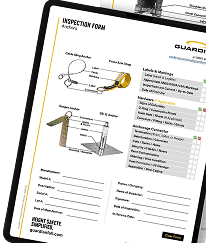
Free Download
Fall Protection Pre-Inspection Checklist!
Help your team catch hazards before work begins.
Host - Mel Moss
Director of Marketing at Guardian
Johnathan Jacobs
Director of Training & Safety at Propel Career Academy
Transcript
Jonathan Jacobs (00:00):
I love it when a leader puts a harness on and goes up into a tripod, gets suspended in the air, and gets to understand the harness that they have budgeted for their team. As you get the leadership bought in and they start to understand what the field sees, I think that's one of the easier ways to get the field team to buy into what's going on.
AI Intro (00:21):
Today's guest is Jonathan Jacobs, director of Training and Safety at Propel Career Academy here to talk about what it really takes to build a safety culture that sticks.
Melissa Moss (00:30):
Walk us through what it looks like at a job site and why it's so dangerous.
Jonathan Jacobs (00:34):
The one thing that I noticed that is a quick breakdown on flow of work is how are people communicating? A lot of it's just listening and understanding. So going onto a job site, I just thought it was like a walk at a park. I stepped over an open hole one time I crossed a barricade, but as I started peeling back the first layer of that onion, I started realise that safety was kind of fun.
Melissa Moss (00:57):
How do you think digital tools like ai, how are they going to impact safety in the way people work?
Jonathan Jacobs (01:02):
I was kind of nervous about it, but
Melissa Moss (01:07):
The best safety equipment in the world won't help anyone if your crew doesn't believe in using it. If your team doesn't feel comfortable speaking up when they know there's something wrong, there isn't a single piece of gear that will make a difference. The gap between okay and effective safety programmes comes down to culture. Is safety first just something you say or is it something you live every single day? I'm Mel Moss, Guardian's, director of marketing, and this is the height safety standard. Your definitive playbook for safer, more effective work At Height, let's head a higher standard for safety starting now by building a culture that actually sticks. Welcome to the height safety standard, where we ditch good enough and set a higher bar in height safety, because when you take a 360 degree approach, the safe choice is the simple one. That's our gold standard.
Melissa Moss (02:00):
Height, safety, simplify. Trying to reach that standard without real buy-in from your team, not happening. Just ask today's guess. Jonathan Jacobs otherwise known as jj, who knows exactly what it takes to shift a safety culture, and that's because he used to be the guy breaking the rules. JJ told us that early in his career he was the reason for the new safety posters, the guy who always found shortcuts and pushed boundaries. But after a mentor helped him gain a deeper understanding of safety's importance, he became one of the industry's most effective voices for building safer cultures. As Propel Career Academy's director of safety and training, he's helped companies transform their approaches in getting workers to comply and more importantly, care. Welcome to the height safety standard. Jonathan, let's set a higher standard for safety by building cultures that actually work. How was the week for you?
Jonathan Jacobs (03:03):
It was pretty fun considering what I've done in the past for safety stand down from Milwaukee tool to when I worked for RAM Tool, even in my last role at Lone Star Equipment Solutions this year was a different approach. I looked at internally inside of our house with our apprenticeship programme and our vocational school, how can I make the most impact on the next generation? And it was pretty fun because in each group that I taught, we had one person who knew it all, and I love those people because you bring them up and you're like, okay, cool. Show me how to inspect a harness. Show me how to properly don it. Let's run through the quick ABCDs of this and let's see how you stack up. And so it's fun to humble 'em, but also use it as a teaching point to say, Hey, this guy thinks he knows everything. I don't even know what, there's going to be new things that come out every day that you never know about. And so we had that lovely opportunity for people talking about fall protection to encounter women that needed to wear fall protection. And that's uncomfortable. That's a hard conversation to have,
Jonathan Jacobs (04:16):
And there's not a lot of options out there. The thought process hasn't been wrapped around the line and construction there. So in each group I was fortunate to have two to three women in each of the different classroom sizes. And so it was fun to go through that conversation and just get them educated, pulled everybody up on my tripod, let 'em softly feel what it likes to be suspended. And it was fun to say, here's trauma straps, what do you do?
Melissa Moss (04:46):
How do you do this? What are you supposed to do?
Jonathan Jacobs (04:49):
Did you pay attention? When we were talking at the beginning of all this and I discussed trauma straps and how do you give yourself relief in this unfortunate scenario? And it's fun because somebody's like, one of the guys started to get really nervous about it and I said, okay, no problem. And I just pulled the release on my four to one and he kicked down quickly and he's like, man, I don't ever want to fall. So you want to live in a world of restraint. Perfect. I'm not mad at that.
Melissa Moss (05:19):
That is great. I love it. I love it. Alright, jj, let's start with your origin story. You mentioned you were literally the reason for safety posters early in your career. What changed and how did you go from being that guy to leading safety programmes?
Jonathan Jacobs (05:35):
Well, first of all, thanks for having me on, Mel. It's good to connect and get to have this conversation, right? It is important too, build a safety career that actually works. I think a lot of that comes from the experiences we've had. And so a great starting point for us to jump off with. I worked for some pretty substantial power tool companies. Both of 'em have red as their main colour and part of my job was to get onto job sites and sell more products, sell more accessories, anchors, fire shop, all the things that the company has provided. So the goal was get onto a job site, go make a splash. And so I did that, but I didn't have a construction background. So going onto a job site, I just thought it was like a walk at a park, walk through Walmart, like here we go.
Jonathan Jacobs (06:19):
Let's have a good time. Go check out what they're building. It looks pretty cool from here. Can I get closer? And I stepped over an open hole One time I crossed a barricade, I had a safety ninja jump out of the rafter and scared me to death because I was violating his job site's protocol and I hadn't paid attention. I didn't notice any of the indicators that were up because I was there to sell power tools and have a good time, hang out with some contractors and just see what this was all about. So as I progressed with the power tool companies, I was able to start to understand a little bit about safety. It started becoming more of our topic around just the sales meetings, conversations. As new product came out, it became focused items. And so as I progressed in my career in the construction sales industry, I made a transition from the manufacturer to the distributor side of things.
Jonathan Jacobs (07:15):
And so when you gain a customer's order and delivery trucks are running low, you end up being the delivery man. So in order to get on site, you need a safety vest, you need a hard hat, some glasses, you might need some gloves. So I started playing the game based off what I was told I had to have. Then in early 2020 COVID kind of shifted what we were all able to do, and at that time I was a corporate sales trainer for RAM tool construction supply, and our team couldn't travel anymore. As we figured out what COVID meant for sales engagement, we all got claimed as essential workers pretty quick, but we couldn't go across state lines and we couldn't fly. And so the safety team, Kelly Heathing Tin was one of the main guys that just poured into me. We had free time.
Jonathan Jacobs (08:07):
We couldn't make all the customer sales calls. So we started sharing what we were working on and it got to the point where Kelly and the other safety team members would just send me leads and say, Hey, I need you to go talk to X, Y, Z customer and I need you to go sell 'em on type one helmets. So because I got thrust into this, it was pretty tricky. I had to figure out what's a type one helmet even mean? What have I got myself into? But as I started peeling back the first layer of that onion, I started to realise that safety was kind of fun. It was neat to see the innovation that was coming to the field that was going to help keep everyone safe on job site. And so as we all progressed in COVID, we all learned new skills and safety became one of mine. Mine got the chance to go do some pretty awesome trainings, fall protection, confined space related, and it started the fire and now that fire's flaming and just out there safely. Obviously fire extinguishers and fire watch tags, but
Melissa Moss (09:11):
All those good things. Yeah, I can a hundred percent relate with that and reflect back as the first time I ever walked onto a job site. And I did a few of those first missteps too. It was like, can't do that. The ninja will get you.
Jonathan Jacobs (09:25):
Absolutely, because there's a safety guy watching all the time. All
Melissa Moss (09:28):
The time, all the time. So when you walk into a job site or a facility for the first time, what are the signs that you look for as clues about their safety culture?
Jonathan Jacobs (09:37):
Are there signs? I mean,
Melissa Moss (09:38):
That's
Jonathan Jacobs (09:39):
A real easy one. There's some mandated ones, your OSHA sign, your state's work rights signs, but I love it when they spell it out and give you the infographic that says you need composite or steel toe shoes all the way up to the type of head protection that's being required. I'm a big fan of seeing that, and it's just a great way to clearly indicates to everybody. I also love it when I get invited to a job site and I hear about their weekly, they're bimonthly, their safety talks or they're bringing the whole job site together to discuss a topic of safety. Matter of fact, this morning I walked a job that I'll be doing a training on in a couple weeks, met with the safety team, talked about what do they have going on in this project, and it's a good way to understand what their needs are from a training perspective, but then also what are these young men and women they're on the job site faced with?
Jonathan Jacobs (10:34):
And when I get my opportunity to train them, can I impart something with them that's going to help keep them safe? So I'm looking for posters. I'm looking for a strong safety culture. If the company or the GC or even the project has gone as far as to create a hard hat sticker, I love that because every guy wants to put a sticker on his hard hat. It's our merit badges of what we've done in the trades. And guys, I struggle to give up a hard hat because of the stickers they've earned on it. So I love seeing 'em as a safety sticker on instead of just a power tool company or some silly industry specific sticker. But I'm looking for those types of things. I guess the other thing that is a great indicator of what their safety culture is, as soon as you see your first safety person, do they recognise you? Do they come by, introduce themselves to you? If they're busy, got a clipboard talking to a group that makes sense, they can't stop what they're doing. But as a safety professional, a lot of the times I see that a new person on site means an opportunity to go set the record straight. Let's make sure you sell the poster up front. Hey, did you sign in?
Melissa Moss (11:46):
What are
Jonathan Jacobs (11:46):
We doing today? Because that shows that they've got an active eye on what's going on and we'll probably talk about it, but with safety culture, everybody does what they're supposed to when someone's watching them.
Melissa Moss (11:59):
Right. And you mentioned a little bit about the eyes and the voices too. So a significant barrier in safety is workers sometimes not feeling like they have a voice in it. Walk us through what it looks like on a job site and why it's so dangerous.
Jonathan Jacobs (12:14):
I've been fortunate to see a lot of job sites, a lot of different scope sizes, and the one thing that I noticed that is a quick breakdown on flow of work is how are people communicating? The general contractors going to have their form of communication down to all their subcontractors and specialists that are on the site, but then how do all of the specialists communicate? It drives me crazy when I go onto a job site and I see scissor lifts up in the air and it's multiple trades and it doesn't look like there's any kind of a game plan on how me as the electrician and you as the mechanical contractor are not going to overwork on top of each other. We're not going to be inside of each other's close radiuses because everybody's got a goal to hit. Now I've been to some really cool projects where they've got an offensive coordinator, if you will, that says, okay, mechanical, you have to do this electrical.
Jonathan Jacobs (13:14):
You're doing this plumbing, you're doing this, and oh, don't forget, we got carpenters and structural guys in there too. So let's game plan. I need to see your schedule of work and your schedule of work so that way we know when we're going to have overlap and so do we plan to change our schedule? Do we change the hours that we work, but we build a proactive plan in order to get the work done so that everybody can go home safely. But then there's this job sense where it looks like it's bumper cars on scissor lifts.
Melissa Moss (13:45):
It can absolutely
Jonathan Jacobs (13:46):
Like, okay, I'm going to get my whistle and I'm going to stand back like, well, I should just stop, please.
Melissa Moss (13:53):
It's getting a little dangerous out here.
Jonathan Jacobs (13:55):
Oh, yes.
Melissa Moss (13:57):
Yeah. Let's talk about building a safety culture from scratch. Walk us through the first steps on how that can be done.
Jonathan Jacobs (14:04):
A lot of it's just listening and understanding. In all the times I've gotten to engage in the starting process of a safety culture, it's been important to stop and tell me about your business. Show me about your business so that way I can get a better grasp of it. Are we looking at just a construction site that falls under Ocean 1926 or do we also include general industry Ocean 1910? Because a lot of companies have both, but their safety manual doesn't reflect it, and so it's just understanding what is their business, what are their goals? Is this something that they're trying to be proactive? The company has started to grow, they know they need to increase their record keeping. They know they need to get structure and safety and have accountability measures attached and assigned. So if you're building it from there, you understand what's their business, where did they come from and where are they growing to?
Jonathan Jacobs (15:05):
When companies are already established and they're massive size or medium to large size or even just the mega size contractors out there, it's really hard to change that because you've got so many people that you have to get buy-in from. That can be the daunting task of it. When you have commas in the number of people that are in your organisation that need the safety update, it becomes a lot harder. You're going to have to send out a casting net rather than fly fish right up under the bank, under the tree log where the fish is at. You're going to have to try and catch 'em all.
Melissa Moss (15:41):
Now that you've got the common in there too, and you're talking about leadership, you've got to get the leadership bought into these programmes and you're ready to roll out this new safety culture, then how do you get the crews excited about it too? Because like you said, now you've got a larger net.
Jonathan Jacobs (15:55):
Oh, absolutely. Leadership is typically a boardroom size meeting, so you get the opportunity to express why is it valuable to increase the safety culture? What is it going to lead to profitability and staying on schedule and reducing the outgoing dollars so you can get the buy-in at that level. I think it's important to ask every single person in that room to take a step into the field. So if we're requiring X, Y, Z protocol on ladder safety, cool, why don't you come out here with me and let's go do this in front of everybody. So that way the guy who's worked for the company for nine years or the guy who's been there for nine days sees that leadership is going to take the same steps as well. I love it when a leader puts a harness on and goes up into a tripod, gets suspended in the air and gets to understand the harness that they have budgeted for their team because you've got the cost-effective harnesses of the world, the universal fits that are kind of like flex fit hats. They fit for the most part, but not every head's designed for it. Just like not everybody fits in the universal size. And so when they get to feel and understand what is it like, they're like, okay, they might rethink that. Okay, so the padding on the back actually does matter,
Jonathan Jacobs (17:19):
And having one that fits our team member that's five foot three but also fits the right size on somebody who's six foot five, there's a lot to say about that. And so as you get the leadership bought in and they start to understand what the field sees and what the field endures, maybe that's a strong word endures, but what the field goes through in their daily walk on the job site. I think that's one of the easier ways to get the field team to buy into what's going on. I've seen some pretty innovative reward systems, kind of like a loyalty program, if you will. We all have
Melissa Moss (18:01):
Them
Jonathan Jacobs (18:01):
For Chick-fil-A and the different things that we want our points on airline miles, hotels, but I love it when you get that at the contractor level. So hand to foreman, one example I've seen is a poker chip style. Each color of poker chip had a different value. The foreman’s, the superintendents and the safety team on site all had different increments, and the goal is to go out and reward people for doing the right thing, for doing the safe task for pre-task planning, understanding what is their hazard, and asking the question of can we take the need for fall protection out of the equation? Can we bring the item down to the ground and work on it? Can we follow the hierarchy of fall protection here, please? Those guys and girls walk up to 'em, hand them a chip and that they can redeem at the free goods store, the safety store, because they may want a nicer pair of safety glasses or whatnot, and maybe they just want a power tool or something that could be in that store, but it's a great way to get some buy-in. I like to build people up rather than tear 'em down. Having been in the training space for pretty much my whole working career, I've had much better results when I can take somebody point out what they're doing, great, elevate and discuss where they're coming up short, but rather than make an example of them, everybody gets to learn. And now I've got that person's buy-in. The next time I say, Hey, hey, hey, we're going to do it this way. I'm about to blow my whistle.
Melissa Moss (19:40):
And speaking of blowing your whistle, then, how do you handle the accountability when someone does break the rules and you are blowing the whistle? What does that look like in practice?
Jonathan Jacobs (19:50):
It's tough. I mean, when you think about contractors and what they were 20 years ago when I started into this industry too, where we're at now, you've got a lot of personality differences. You've got a lot of change in what you can and can't say and how you handle things. So depending on the severity, because everything's a scale with an infraction, when you miss an opportunity to be safe, it could be that you took your hand off on a ladder while you were climbing up because you wanted to take a picture. Is it the scariest thing you could have ever done? Probably not. However, in that moment, you put yourself at risk. So that's when you say, okay, come on down here. Hey, give me three minutes everybody. This is exactly why we're not going to do this anymore. No big deal. Hey buddy, I'm going to make a note in my book about this. I'm not raking you over the coals over this one. We just taught everybody something real quick in three minutes. Thank you for being my volunteer. Now everybody, let's get back to work.
Melissa Moss (20:56):
That's excellent.
Jonathan Jacobs (20:58):
But I also think that the person that works to my left, the person that works to my right, the person in front of me, the guys on my floor, my crew for that application, those guys I've got to hold accountable as well as I expect them to hold me accountable. We all have those friends in life that tell us the things we don't want to hear, but we need to hear. And we love those people till the end of time because they are so much in tune with us that they're going to call us out, they're going to get us back on track, but they're also going to recognize when something's off. And that's what the people in my crew on my floor are is we're all on the same team. We've all got the same goal at hand, so I want to make sure that you're doing it safe so that I can do it safe and everybody else gets safe. And then, oh, by the way, stop works really aren't fun. We don't get to work. We get to sit around or we get to go home. And most of the guys performing the work are hourly, so they want those hours, so don't mess with their hours. So let's stay safe and let's go home. I do have a little bit to add to that as far as the safety culture. And when speaking up about it, recently I attended the Teaks Fallen Workers
Jonathan Jacobs (22:17):
Memorial,
Jonathan Jacobs (22:19):
And that was, that's an awesome thing that Teaks and OSHA have put together. It's time of the year where they're going to remember the workers that have fallen lost their lives in construction. And it's a sobering moment because you hear from the family that's able to voice how their life has changed. And this year was pretty emotional, and it was just a nice opportunity to hear these families, and it kind of reinvigorated me. Not that I needed a little wind in myself for being a safety minded first person, but it just kind of grounded me and helped me remember that from the guy who's worked all the way up into his retirement on the job site to the Apprentice that's coming through my school. Everybody has a reason for why they're working, and it's typically family. They want to earn income, they want to make a life for themselves, and this is the avenue that they've chosen.
Jonathan Jacobs (23:22):
And so they need all 10 fingers, all 10 toes. They need both eyes, they need their ears, everything they took to work with them that day, they need it. So if you don't feel safe, say something. And I tell every one of my trainees that you are empowered to speak up. It may not be received exactly as you hope so to where they just roll the red carpet out for you, but it's all about in how the delivery of your message is. So if you just throw a fit about something being unsafe, rather than going to your foreman, going to your site safety rep and saying, Hey, catch me up on this. I feel like this harness is not safe. Or I feel like these gloves are not protecting my hands. Is there something else? Have a conversation rather than just blame or throw shade at something because the employer's done their best to provide that safety and that net for that company. So all you got to do is talk about it,
Melissa Moss (24:26):
Right?
Jonathan Jacobs (24:27):
But if you don't talk about it, they will never know.
Melissa Moss (24:32):
Exactly. Exactly. And do you think it's more so maybe on the older generation or the younger generation? Because as you look at the next generation that's coming up of skilled labor is that you're training now, and you mentioned that a little bit earlier too, what excites you about the future of the safety culture within that generation?
Jonathan Jacobs (24:52):
I think it's with every impressionable mind. When somebody decides, I'm going to choose this vocation in life. I'm going to go be an electrician, I want to be a welder, I want to go work for a general contractor. So when they start that process, that is the best time to implant safety in their mind. You're also implanting the trade that they're looking into. So there's going to be a lot of information going into that individual, but if we can catch 'em early, that's when we've got the best chance to have that person go be a craftsman at their craft, but also carry a safety mind with them as they go. And then they're going to be the ones who's not going to buck the system. They're the one who might push for innovation to say, hold on, there's a better safer way to do this. But catching 'em early is definitely the best case. Unfortunately, the other best time to get somebody's attention is after an incident.
Melissa Moss (25:48):
An incident
Jonathan Jacobs (25:49):
When attention is high and when people are focused on what just happened, we've got to retrain. We've got to investigate where was the failure that caused that result from near messes all the way into the inevitable fatalities. Companies will have to get reactive at that point in time, but that's a great time to start stealing the proactive thought process because as they investigate, you're going to find out that somebody probably saw the unsafe activity and just didn't talk about it, didn't say anything.
Melissa Moss (26:26):
So speaking of innovation and new technology, how do you think digital tools like ai, how are they going to impact safety in the way people work?
Jonathan Jacobs (26:34):
AI is pretty neat.
Melissa Moss (26:36):
It's pretty neat.
Jonathan Jacobs (26:37):
Yeah, I was kind of nervous about it, but a friend of mine recommended that I just be nice to it and make sure that all the computers think that I'm one of the nice ones. And so I start my chats or my GBT or my Geminis or any of my AI searches with, hello, how are you today? It's good to see you. Thank you for your help. It's polite. And so that's my service announcement is be nice to ai. When the computers take over, you want to be on the good list, but what I'm seeing with it is the ability to create documents quickly on the fly, and I love the ability to go out and create a new safety inspection, whether it's a building audit, my fall protection, annual inspections, or just simple job site JHAs and the ability to capture the best things that are on the internet and bring that all to you.
Jonathan Jacobs (27:33):
I have a feeling that BIM modelling and ai, at some point in time, there's going to be a connection where the BIM modelling that all these contractors are using to design what they're putting up in the air is at these data centers or these Tesla factories, the semiconductors or all the way to the new style of apartment complexes, and how do they make all the trades and utilities crossover? I've got to believe that AI can plug into that and say, by the way, this is your safety checklist for when you get to this space. And I think that would be a great way to start building safety into the job bids and then the awarded packages and then what goes on to estimators. And if all of those pieces can be connected, it's going to give that contractor the best leg up on quickly and safely providing the best safety system they can because reduce a lot of the noise.
Melissa Moss (28:33):
A hundred percent. And excellent perspective on that. Had not thought of it from that angle, but I love it. Jj, thank you so much for showing what it takes to build safety culture that actually works. If listeners want to learn more about Propel Career academies safety training programs, where do they need to go?
Jonathan Jacobs (28:52):
It's pretty simple. Just Google Propel Career Academy and it'll land. You're pretty quick and easy. We've got our landing page with some opportunities to check out what we're doing with all media. You've got to constantly evolve it. So we're looking on fresh perspectives that we can add to our websites. And then of course, we cannot forget about all the social medias, whether it's Facebook, Instagram, LinkedIn. I think those are the three main ones. I haven't been invited to do any TikTok videos, so I don't think we have TikTok as of yet.
Melissa Moss (29:25):
Okay.
Jonathan Jacobs (29:28):
But yeah, we're pretty easy to find. We are located in San Antonio, Texas, military City USA. We're right close to the airport and yeah, we love San Antonio.
Melissa Moss (29:37):
Thank you. Thank you.
Jonathan Jacobs (29:40):
Absolutely.
Melissa Moss (29:41):
That's a wrap for today's conversation. Thank you so much for tuning into Height safety Standard, where we're ditching good enough and setting a higher bar in height safety. Because when you take a 360 degree approach, the safe choice is the simple one. If you want to explore more ways to set a new height safety standard, visit guardian fall.com to explore compliance resources, training programs, and digital tools, including Gabby, your 24 7 AI height safety assistant, or visit guardian fall.com/podcast to explore more episodes and get our fall protection inspection checklist. Let's set a higher standard for height safety starting now.
