- Podcast
- /
- Choosing the Right SRL for the Job
Choosing the Right SRL for the Job
Watch and listen on
DESCRIPTION
In this episode of The Height Safety Standard Podcast by Guardian, Host Melissa Moss speaks with Tony Nasoni, Sales Manager at Bell & McCoy Companies, about choosing fall protection that matches the work being done. Tony explains how job height, leading edges, obstructions, anchor locations, and environmental conditions influence SRL selection. He also describes how onsite demonstrations help workers understand fall arrest forces and the hazards around them.
Practical preparation extends beyond buying equipment. Tony Nasoni outlines the importance of following anchor installation instructions, understanding fall clearance, inspecting equipment before every use, and establishing a job-specific rescue plan. He also discusses Guardian’s Hero SRL line, including its color-coded class identification, line lock performance, and protected labels.
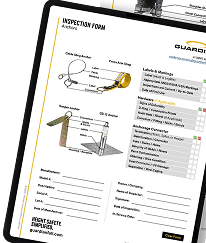
Free Download
Fall Protection Pre-Inspection Checklist!
Help your team catch hazards before work begins.
Host - Mel Moss
Director of Marketing at Guardian
Tony Nasoni
Sales Manager at Bell & McCoy
Transcript
Tony Nasoni (00:00): There's a good chance you're going to still hit the ground. Just because I have a lanyard and a harness doesn't mean I've got the right equipment. That person falls and they may sway to the side and hit the side of the booms, or if there's some obstruction in the way, they could hit that obstruction.
Melissa Moss (00:12): Which barriers to safety do you run into most and how do you work through those?
Tony Nasoni (00:17): The biggest barriers we see is...
AI Intro (00:20): Today's guest is Tony Nasoni, sales manager at Bell & McCoy Companies, where he helps customers find the right safety solutions for their needs. With a hands-on background in construction and fall protection, he's passionate about helping workers stay safe on the job.
Tony Nasoni (00:34): Know your rescue plan and make sure it's job specific. Are we five feet off the ground or are we 25 feet off the ground? If I'm using a six-foot shock absorbing lanyard and I'm not at least 20 feet off the ground, I'm not going to be protected.
Melissa Moss (00:46): Looking ahead, what excites you about the future of safety?
Tony Nasoni (00:49): The biggest thing is...
Melissa Moss (00:52): There are more SRL options on the market than ever, all of which are rated for different conditions. With all of these options available, grabbing the wrong one off the truck is easy. I'm Mel Moss, Guardian's Director of Marketing, and this is the Height Safety Standard, your definitive playbook for safer, more effective work at height. Let's set a higher standard for safety starting now by choosing the right SRL for the job. Welcome to the Hight Safety Standard where we ditch good enough and set a higher bar in height safety. Because when you take a 360 degree approach, the safe choice is the simple one. That's our gold standard, height safety simplified. And a few decisions carry more weight than the worker's choice for the connector that'll catch them if they fall. Today's guest has spent a decade helping companies make that decision correctly. Tony Nasoni is sales manager at Bella McCoy, where he's sold and trained on fall protection for 10 years.
Melissa Moss (01:44): He's led authorised users training, run onsite demonstrations showing workers exactly how their bodies react in a fall, and he knows ANSI standards better than just about anyone. Welcome to the height safety standard, Tony. Let's set a higher standard for safety by getting the equipment right.
Melissa Moss (02:05): Tony, you've spent 10 years selling and training on fall protection. Tell us how you got into this work and what keeps you in it.
Tony Nasoni (02:12): Absolutely. Yeah. I actually started off in construction and my first experience with fall protection, I was about 21 and my safety manager said, "Hey, we've got to get you up in a boom lift. Here's a harness and an SRL." And I said, "Okay, is there anything I need to know?" He said, "Well, if somebody comes by with OSHA, just tell them that you were trained in your ABCs." And so I laughed and I said, "Okay." They very quickly showed me how to put the harness on and how to connect it to the boom lift, and up I went and worked, and that was my first experience in fall protection. So from there, we expanded to grow our knowledge in fall protection and the safety, and we had a demonstrator come on site and do a fall protection authorised user demonstration. From that point on, I kind of felt, I was like, wow, this is pretty neat.
Tony Nasoni (02:54): Not only is it neat, but it's something different that actually it's helping keep everybody safe and go home to their families at the end of the day. So over the years, I kind of built a relationship with this person that did the training and got an opportunity to get into the safety business myself and get out of the construction side of it and help people become more educated on safety and fall protection.
Melissa Moss (03:16): That's awesome, Tony. Thanks. So let's start with our show's biggest question. When you hear height safety excellence, what does that mean to you?
Tony Nasoni (03:24): As a rep, it's more than just supplying equipment to somebody. It's helping customers choose the right solution for the work, understanding how to use it, building a strong safety programme. A lot of times that means listening to the people that are doing the job, not just taking the employer's word for it, but going and talking to the people on the ground, supporting them with training and planning and just really installing trust in them that we're going to give them the best solution for the job and recommend what's best for them. It's simple. For me, it's making sure whoever works at height or in fall protection goes home safely.
Melissa Moss (03:58): Absolutely. Couldn't agree more with that. And you run onsite demonstrations that show workers what happens to their body in the event of a fall. What do you see during those demos that people normally don't expect to see?
Tony Nasoni (04:11): Well, I always like to, when I'm doing an onsite demo, I like to bring out... OSHA's requirement is there can't be any more than 1800 pounds of force put on the body in the event of a fall. Obviously, an SRL is designed to reduce that amount of force put on the body, but when they see that demonstration, it still is a violent demonstration. And so you kind of see their eyes light up and like, "Wow, okay, it's not as smooth and easy as I thought it was going to be if I were to be in a fall." So it really puts it in perspective for them and it just hits home. So a lot of guys don't understand, or men and women, they don't understand the difference between how you fall. A man typically will fall headfirst because we're top heavy. Women will typically fall feet first.
Tony Nasoni (04:54): So when they see we have just a dummy and it's a very controlled fall, that person falls and they may sway to the side and hit the side of the booms, or if there's some obstruction in the way, they could hit that obstruction. So it gets them thinking, "Am I using the right equipment? Maybe I need to relook it and rethink what I'm doing."
Melissa Moss (05:12): Yeah, great points. Which barriers to safety do you run into most and how do you work through those?
Tony Nasoni (05:18): So every job site is different. We try to put together plans for job sites because everything requires something a little bit different. The biggest barriers we see is on people not being educated and just not knowing. I love going out and doing those trainings to educate the end user, but also at times it could be budgets. I was on a job site earlier this week where we were at a firetruck manufacturer and they are testing the ladders that go on top of the firetruck, and these ladders can be from 53 feet to 105 feet long. They're suspended in the air about five to six feet off the ground. An employee has to walk all the way across that ladder as it extends to inspect each moving part to make sure nothing's rubbing, make sure it's operating perfectly. There's a rail on the side, but it's not designed to be used horizontally.
Tony Nasoni (06:04): It's designed to be used vertically. So that rail, when it's horizontal, is not tall enough, it doesn't fall under the guardrail guidelines, so they need some kind of fall protection. Their issues, they've got overhead cranes, they've got a lot of moving parts, so they can't have any obstructions above them. It's too short of a distance from the ground to put anything anchored below their body. There's several different obstacles that we might maybe get our engineered team involved in or come up with a different process for the end user without limiting them or slowing production.
Melissa Moss (06:41): That's a tricky situation there because you said you've got everything from left to right and top to bottom that's coming in your way. So you're obviously helping customers choose the right products for the situation. Talk to me a little bit about how you do help customers land and shoes on the right SRLs.
Tony Nasoni (06:59): The biggest thing is understanding the application, knowing what is it? Are we five feet off the ground or are we 25 feet off the ground? Is there a leading edge that the person could potentially fall off of? Are there obstructions in the way? What kind of anchor point do we have? All those things are going to help me decide whether they need a dual SRL to be 100% tied off or they're going to need a 30-foot SRL because they've got to be anchored 20 feet above their head. Another factor that comes in is are they around welding or hot work or grinding? Are they working in extreme hot temperatures where they have to have something a little more robust or is there a lot of acaustics around where a webbing may not hold up that well? So we see a lot of those different applications and all that tells us, okay, you either need Kevlar, you need webbing, you need galvanised steel cable SRLs, or you need this snap hook to go with this application.
Tony Nasoni (07:59): So the biggest thing is understanding their job site and what their job application is.
Melissa Moss (08:03): Yeah, and you mentioned a little bit on anchors, so anchorage connectors, what do most people get wrong when they're selecting the right connection point?
Tony Nasoni (08:12): Yeah, so I saw it a couple of weeks ago where they're using shackles as an anchor point and yeah, that shackle, it could probably lift 20,000 pounds, but is it rated and tested to be used as a man-rated fall protection system? The answer is no, it's not. So the biggest thing is making sure you're using equipment that's rated and tested for man-rated fall protection systems. And then we've seen at times where people get roofing anchors and they've got 20 holes for screws and they're just choosing what holes they want to put the screws in and not filling every hole in that anchor. Well, as men, unfortunately, sometimes we don't read instructions and we just kind of go with what we think is best, but it's very important in fall protection that you read your instructions, you understand your equipment, and you're installing it properly. Another thing we see is not using the right type of bolt or screw for these anchor points because there are specified bolts and screws that you need to be using to make sure that they're anchored down correctly.
Melissa Moss (09:12): Absolutely. Yeah, and not all fasteners work with each anchor point and some are not tested and vice versa. So you've trained a lot of authorised users. What are the biggest things to make sure a worker understands before they complete their training?
Tony Nasoni (09:27): Know your equipment. That's first and foremost, know your equipment and make sure you have the correct equipment. Just because I have a lanyard and a harness doesn't mean I've got the right equipment. We talk a lot about fall distance calculations. If I'm using a six-foot shock absorbing lanyard and I'm not at least 20 feet off the ground, I technically have the correct equipment, but I'm not going to be protected because as you know, with the free fall, the tear out, and all the factors that go in that fall distance calculation, there's a good chance you're going to still hit the ground. So first and foremost, know your equipment, make sure you have the right equipment for the job. Second, make sure you know how to use that equipment properly, how to put a harness on correctly, how to instal your connector, your SRL or lanyard to the anchor point and then to your body and installing anchor points correctly.
Tony Nasoni (10:21): Third, I like to drive home that you need to inspect your equipment and as the user, not once a day, not every other day, not once a week, it's every time before you use it. I tell them all the time on the job site, if I come in the morning, I put my fall protection on, I go up, I do my work, I come down for lunch, take it off. When I come back from lunch, I need to reinspect my equipment. I don't know if somebody drove over it with a forklift, if it was thrown in the back of a truck and hit something sharp and maybe ripped a piece of the threading, bent some of my hardware, anything like that. So every time before you use your fall protection, you need to inspect it. One of the things I like to drive home too is know your rescue plan.
Tony Nasoni (11:04): Everybody's worried about getting in fall protection and being safe, but then we sometimes don't think about how are we going to save that person after they have fallen? As you know, Mel, when somebody falls in a harness, it can be you only have minutes to get that person down before it can cause permanent damage or even worse. So know your rescue plan and make sure it's job specific.
Melissa Moss (11:27): 100%. I couldn't agree more with you, Tony. So let's talk about what's new. Our team at Guardian recently launched our new Hero SRL line. What stands out to you about it and where does it fit for the customers that you work with?
Tony Nasoni (11:40): Man, I really love this. It's ingenious, honestly. I can't believe it's been this long before we put together some kind of programme like this, but my favourite thing about our hero line is the colour code class identification. It's easy for the user, for the safety manager, for our distributors to ensure that they are getting the right product for the job. So our light grey SRLs are going to be our class one classification SRLs, and then our gold or yellow SRLs will be the class two. It's a very easy visual for everyone to identify and make sure, "Hey, I'm using the right equipment or maybe I'm not." So that's my first point on that. And the second is the line lock. We've heard from several contractors, SRL is locking me up every time I try to go move or bend over and it causes me to fall and causes more nuisance than anything.
Tony Nasoni (12:30): So the line lock performance that our new SRLs have is class leading. It's going to be a lot better, make it for a lot smoother movement on the job site and just make the workers' life a lot easier. And then the third thing, it's one of the biggest issues we see is labels always getting scratched up, not legible, falling off. So our new recessed compact design that helps protect those labels is just a beautiful design as well. So I'm very excited for this brand to come out.
Melissa Moss (12:58): I am too, and it looks good too. So yeah, looking ahead too, what excites you about the future of safety?
Tony Nasoni (13:06): The continued growth to want to be educated. We get more and more calls for onsite trainings, for people wanting to know more, for people wanting to be competent person trained. So that is very exciting because as you know, we do more trainings every year, but unfortunately injuries continue to grow as well. So until injuries stop, that number stops growing, we've got to continue to do more and more trainings. But I see more of a demand for that and an urgency from not only employers, but employees wanting to know, "Hey, how do I stay safe? What do I need to do to make sure that I'm safe on the job site?" So very exciting.
Melissa Moss (13:42): Very good. And if you had to give listeners one last piece of advice, what would you tell them to make sure they're ready to protect the people?
Tony Nasoni (13:49): Definitely that falls are still the number one cause of injuries in the workforce. So please, if you don't have a great programme or you're not confident in what you're doing, you have questions, reach out to us at Guardian. We're here to help and we want to help, and that's what I do for a living and I love it. Know your job site requirements, your OSHA requirements, make sure you have the correct equipment for the job. There's no price you can put on safety, and then make sure you have a rescue plan.
Melissa Moss (14:14): 100%. Tony, thank you so much for your valuable insight. If listeners want to learn more about Bella McCoy or connect with you, where should they go?
Tony Nasoni (14:22): Absolutely. Yeah, we have a website, bellmcoy.com. You can go to the Tool and Safety Solutions Division and click on that, and you'll be able to find my contact info along with the rest of our team's contact info, and then as well as LinkedIn, if you want to reach out. I plan on posting this as well on my LinkedIn, so feel free to reach out any way you can.
Melissa Moss (14:39): Awesome. Thank you, Tony.
Tony Nasoni (14:41): Thank you. Appreciate it.
Melissa Moss (14:42): That'll wrap up today's conversation. Thank you so much for tuning into Height Safety Standard, where we're ditching good enough and setting a higher bar and high safety. Because when you take a 360 degree approach, the safe choice is the simple one. If you want to explore more ways to set a new height safety standard, visit guardianfall.com to explore our compliance resources, training programmes, and digital tools, including Gabby, your twenty four seven AI height safety assistant, or visit guardianfall.com/podcast to explore more episodes and get our fall protection inspection checklist. Let's set a higher standard for height safety starting now.
