- Podcast
- /
- Choosing the Right Height Safety for Roofing
Choosing the Right Height Safety for Roofing
Watch and listen on
DESCRIPTION
In this episode of The Height Safety Standard Podcast by Guardian, Host Melissa Moss speaks with JT, Account Executive at QXO, about height safety in roofing and how to choose the right fall protection for different jobs. He shares how his early experiences in roofing shaped his commitment to safety and explains the importance of assessing job site hazards, roof slope, and anchor points before work begins. The discussion covers proper harness fitting, choosing the right safety equipment, and building a strong safety culture through training and planning. JT also talks about industry partnerships, new safety equipment, and the growing focus on dropped tool prevention. He ends the conversation by encouraging the next generation of workers to make safety a priority on every roofing job.
JT shares how his experience in roofing shaped his approach to height safety and explains why every roofing job requires careful planning before work begins. He discusses the importance of assessing job site hazards, roof slope, anchor points, and rescue planning to choose the right fall protection system. JT highlights the value of proper harness fitting, competent person training, and making safety a daily priority for every worker. The conversation also explores how strong partnerships, better safety education, and new equipment can improve protection across the roofing industry. The episode ends with JT encouraging the next generation of workers to embrace safety and continue building a stronger safety culture.
Free Download
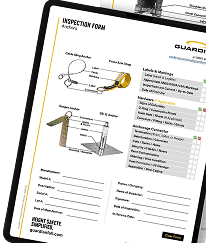
Fall Protection Pre-Inspection Checklist!
Help your team catch hazards before work begins.
Host - Mel Moss
Director of Marketing at Guardian
JT QXO
Account Executive at QXO
Transcript
Melissa Moss (00:00): On the roofing job, what qualities define height safety excellence?
JT (00:03): The consistent execution of the safety plan, which requires an educated view, a lead that can disseminate and manage the authorised persons that are there, the team that prioritises safety first, I think that's very important.
Melissa Moss (00:19): Meet JT, account executive at QXO in Medford, Oregon. A safety advocate who's seen falls firsthand and now works to make sure the next generation doesn't repeat them.
JT (00:30): There are a couple things that stick out to me about safety and that is just the peer number, the statistics about how many workers suffer injury. Because I have known people who have lost their ability to have normal life because of injuries at fall. I'm finding that since we have improved the culture of safety that the kids that are entering the workplace, they're coming in knowing there's something that can be done and should be done to keep them safe.
Melissa Moss (00:58): What developments and innovations do you think will make the biggest impact on roofing safety in the future, JT?
JT (01:04): I think first of all -
Melissa Moss (01:07): As any height safety professional can tell you, no two roofs are the same. Slopes and anchor points will be totally different from one roof to the next and the work itself rarely stays in one place. The equipment that protects a worker on a flat commercial roof might leave them exposed on a steep residential one, making roofing one of the most demanding applications in all of height safety. So how do you build a height safety plan that fits the job in front of you? I'm El Moss, Guardian's Director of Marketing, and this is the Height Safety Standard, your definitive playbook for safer, more effective work at height. Let's set a higher standard for safety, starting now by matching the right protection to the work being done. Welcome to the Height Safety Standard, where we ditch good enough and set a higher bar in height safety. Because when you take a 360 degree approach, the safe choice is the simple one.
Melissa Moss (01:57): That's our gold standard. Height safety, simplified. And a few applications test that idea like roofing, where the right call depends on more factors than you can count. Today's guest knows that world inside and out. JT is an account executive at QXO in Medford, Oregon, who came up through the trades and lived the realities of working at height. He's seen serious falls and dropped tools. Today he's committed to helping workers choose the right protection and understand how to use it. Together we'll walk through how to think about height safety for roofing applications from selecting the right anchor and harness to choosing between lanyards and SRLs based on the work being done. Welcome to the Heights Safety Standard, JT. Let's set a higher standard for safety by choosing the right protection for the roof. JT, you came up through the trades yourself. Tell us a little bit about your history in this work and how your own experiences have shaped the way you think about height safety.
JT (02:56): I fell into the roofing business in 1977. It was an opportunity for me to work a lot harder than I expected but make a lot of money compared to what the standard rate of pay was at that time. I think minimum wage was about 285 and I don't even know if I was making that. I jumped into roofing. It paid well, it demanded a lot. And quite honestly, if I'm telling the truth about my whole story, the first day that I worked there, OSHA would've fined the company thousands of dollars for how I had to work that day. I was in a man lift filled with rolls of built up roofing that didn't quite reach the top of a very tall barrel. And so my job being the first hand of the job for whatever reason was to stand on top of those rolls, pull them up out of that man lift and push them up to a guy that was grabbing onto them that was on the roof.
JT (03:51): So that's how my day went for most of the day. And then at the end of the day, we had to cover that roof with Visqueen and there was no safety stuff at that point in time. So it was like you got a handful of battens handed to you, a bag full of nails and you were instructed to slowly create your own little ladder system going down the visqueen, tacking it on. And that was a very scary start. I don't even know why I went back for the second day, but that has always been in my mind. A couple other incidences that happened along the way that were not great in terms of safety. I was fortunate to survive them. And then in 89 when I was asked to come to work for the distribution that we bought all of our materials from, that's when I think I started this quest for what ended up being a great partnership with Guardian about 15 years ago and it really fulfilled my want, my real want to make sure that these young people that I was now serving didn't go through those things.
JT (04:53): Certainly we have protocols in place now that are supposed to help to eliminate that, but I just really felt like from the distribution standpoint, we had to do a better job of creating this awareness, first of all. And I'm just very fortunate that Guardian took some crazy ideas from me about how we could change this and they've been a partner that's been very unique in my career and I think has benefited my territory, the region that I serve in ways that we probably will never really know. I'm very proud.
Melissa Moss (05:27): That's really incredible. And you've had quite the experience and I'm sure there's been some pretty scary moments throughout your career of working on the roof. So when you walk onto a roofing job for the first time, what are the first things that you're going to assess?
JT (05:40): Because of the training that we've received and my experiences, I've always thought that risk management, I guess, is the best way for me to put it. As soon as I walk onto a property, that's what I am immediately thinking. And that's regarding the property around buildings, the terrain, those kind of things are the first things that I assess. I know that our business delivers a lot of material. We teach our guys that are out there operationally to do the same thing to view the properties first. We take pictures and those kind of things for our own purposes. But if I were a roofing company, that's what I would be doing. I would be looking for where the hazards and the potential are exits where there's pedestrian traffic, if we're on a job like that, potential for damage from drop tools and roofing, those kind of things.
JT (06:29): And then as we move forward, just how accessible is the terrain surrounding the job in regards to the work and also thinking a little bit forward from that, how is that going to affect a rescue plant?
Melissa Moss (06:45): Yeah. So walk me through how the slope and the substrate kind of shape your height safety decisions on the roof.
JT (06:50): Sure. I would say that the slope, once we get to that, determining what kind of systems have to be designed and installed or chosen, whether or not we're going to be using yo-yos, ropes, horizontal lifelines. And then we have to determine what the substrate is so that we have anchor points that will meet the requirements and can be installed and used properly. We use a lot of the halo anchors with our systems in delivery, horizontal lifelines also. So the choices as far as anchors, we have a multiple variety of those in our store so people can use them as permanent or temporary with the pitch pros are very popular and a lot of times we advise our customers to just build those into their roof bids and leave them for trades that are coming after them.
Melissa Moss (07:41): On the roofing job, what qualities define height safety excellence?
JT (07:45): Simple answers. I thought through that. I think if we're speaking about people, then I believe that I would say the consistent execution of the safety plan, which requires an educated view and a lead that can disseminate and manage the authorised persons that are there. I know that we've been very involved with Guardian in helping to create competent persons with many of our companies, multiple competent persons with some that I'm very proud that we've done. I just think the team that prioritises safety first, I think that's very important.
Melissa Moss (08:20): Very nice. So you've got lots of decisions to make up there. You've got anchors, you've got hard harnesses, you've got SRLs, you've got lifelines, you've got kits. How do you choose between those options for the job?
JT (08:32): I think it's kind of that question I was working through this a little bit more last night and it's kind of an abstract question. I think first of all, and this is something that with our Guardian partnership, I keep coming back to that, Mel, because it is really our singular safety partner here, as you probably know. But the harnesses we feel need to be fitted to each person. QXO Medford has over a period of time taken this position with Guardian that as they're introducing new products and we train on them routinely through the year so that as they come out, we feel like we're right at the forefront of showing their next greatest version of products. We really enjoy doing that. But we've also taken the position that all of the safety harnesses that we sell, we keep an extra of all of those things so people coming in can actually be fitted.
JT (09:27): We've just found over the years that all the different kinds of body types and people, shapes and sizes, not one fits all. We feel very blessed, I guess, at this point that we're able to fit people appropriately before they leave. And I know our ops manager, also my wife, and she was a corporate safety officer for several years. So we're very centric to safety, both of us. So she takes a lot of the lead with people that come into the shop to help fit them with the right gear. And then the other thing that we do is once they choose that, she's very good about putting that first date of use in the harness and letting them kind of know what those labels and those kind of things are about there. That's how we are managing that. And then getting to the question specifically anchorage depends on the slope, what the substrate's made of, metal, wood, steel, concrete.
JT (10:22): Those are all fairly normal that we'll find in the different kinds of works that we are selling to our customers.
Melissa Moss (10:30): Yeah. I love the fact that you talked a lot about fitting and how important that is. It's a big thing that I like to talk about too, especially when it comes to the different sizes bodies because everyone is different. And so if you have those five points of adjustment, you can get that proper fit that you'd need, but it is taking the time to adjust the webbing, adjust the chest straps, adjust the torso, adjust the legs, adjusting the back D-ring, making sure that it is fit properly and it's on the body properly too, just because it's on well or snug or not too tight doesn't mean that maybe the straps are exactly in the right position on the body either. So there's some talent to it. So that's nice to know.
JT (11:08): The other thing I'll add to that that I am really happy to see happening in the industry is we're having young women coming into the industry also. And so the fitment, again, we haven't fitted a lot of women in the years and we're starting to have more women come in that are choosing to get into these positions of need in the work that they're doing. So I have welcomed that, have kind of waited to see this happen in Southern Oregon and we're finding literally by fitting these women that are coming into the industry, the choices are different. And so we're very happy that we've got choices from Guardian to help fit people properly for what they're doing.
Melissa Moss (11:48): Awesome. What developments and innovations do you think will make the biggest impact on roofing safety in the future, JT?
JT (11:54): Obviously we could say AI and 3D printers are going to take the place of roofers. I don't think that's going to happen anytime soon. So I think where we're headed, at least where I'm concerned and what I hope for is the development of partnerships that keep combining these efforts with manufacturing and distribution, even the governing bodies locally, OSHA and insurance companies, SAIF in our area we have L and I think it is in Washington. I just think that a combination of helping people understand all of those involved in safety can take a position of educating it, preparing people so that we're not needing to be policed so much, but that we're sharing conversations about how we can create these incident-free workplaces. This is the one thing that really got my attention as I looked through the myriad of different companies that I could have partnered with and as we just kind of fell into this partnership with Guardian and learned each other and what our real desires were to be part of this culture building and safety, I think that's what needs to continue to change and I hope that we've started something that people will want to model a bit.
Melissa Moss (13:09): Good. So looking ahead, JT, what excites you about where roofing safety and equipment are headed, especially for the next generations of workers that are coming along?
JT (13:17): I think it's the conversation. There are a couple things that stick out to me about safety and that is just the sheer number, the statistics about how many workers suffer injury. There are statistics about deaths because I have known people who have lost their ability to have normal life because of injuries that fall struggle from that. I've had customers who literally had partners fall through skylights on projects and fall to their death. And the result of that and what hangs on to people after that, if that's not an inspiration to make sure that we continue to go this direction, do everything we can to get in front of these young people that I'm talking to routinely in my job that really want to contribute into the traits and a lot of them are interested in whatever it takes to get those jobs done, but they are very interested in being safe in the process.
JT (14:12): I'm finding that since we have improved the culture of safety, that the kids that are entering the workplace, they're coming in knowing that there's something that can be done and should be done to keep them safe so that they can go out and enjoy these dangerous jobs. They're the box of chocolates. If you're in roofing, there is no job that's the same. Yo have to be on your game and prepared for this all the time. So I think the industry is coming up with new equipment. I think we're going to head into a time where the drop tool conversation is going to become more important. Guardian has been a great partner in just bringing that kind of to the forefront in their conversations and we're trying to prepare for that as it becomes maybe the next necessary element in safety gearing up and those kind of things.
Melissa Moss (15:05): Good. Well, we certainly appreciate that partnership too. And JD, thank you so much for breaking down how to think through Hg Safety for roofing and helping us match the right gear to the right job. If listeners want to learn more about QXO or connect with you, where should they go?
JT (15:20): Really simply for me, if they're interested in just shooting me an email, that's at johnjohn.thomas, T-H-O-M-A-S@qxo.com. I'm happy to connect with anybody via that email.
Melissa Moss (15:32): Awesome. Wonderful, JT. That's a wrap up for today's conversation. Thank you so much for tuning into Height Safety Standard, where we're ditching good enough and setting a higher bar in height safety because when you take a 360 degree approach, the safe choice is the simple one. If you want to explore more ways to set a new height safety standard, visit guardianfall.com to explore our compliance resources, training programmes and digital tools, including Gabby, your twenty four seven AI height safety assistant, or visit guardianfall.com/podcast to explore more episodes and get our fall protection inspection checklist. Let's set a higher standard for height safety, starting now.
